
Animal sanctuaries across South East Asia claim to be ethical, but once you dig a bit deeper, you realize that their practices aren’t exactly up to par. The conservation project set in Yok Don National Park is not only the most affordable elephant tour I’ve found, it also follows the strict ethical values of Animals Asia.
After spending hours researching ethical elephant sanctuaries in Thailand, and ultimately giving up – we finally got to witness the magnificent beasts in person. We didn’t see elephants in Thailand, but in the central highlands of Vietnam!
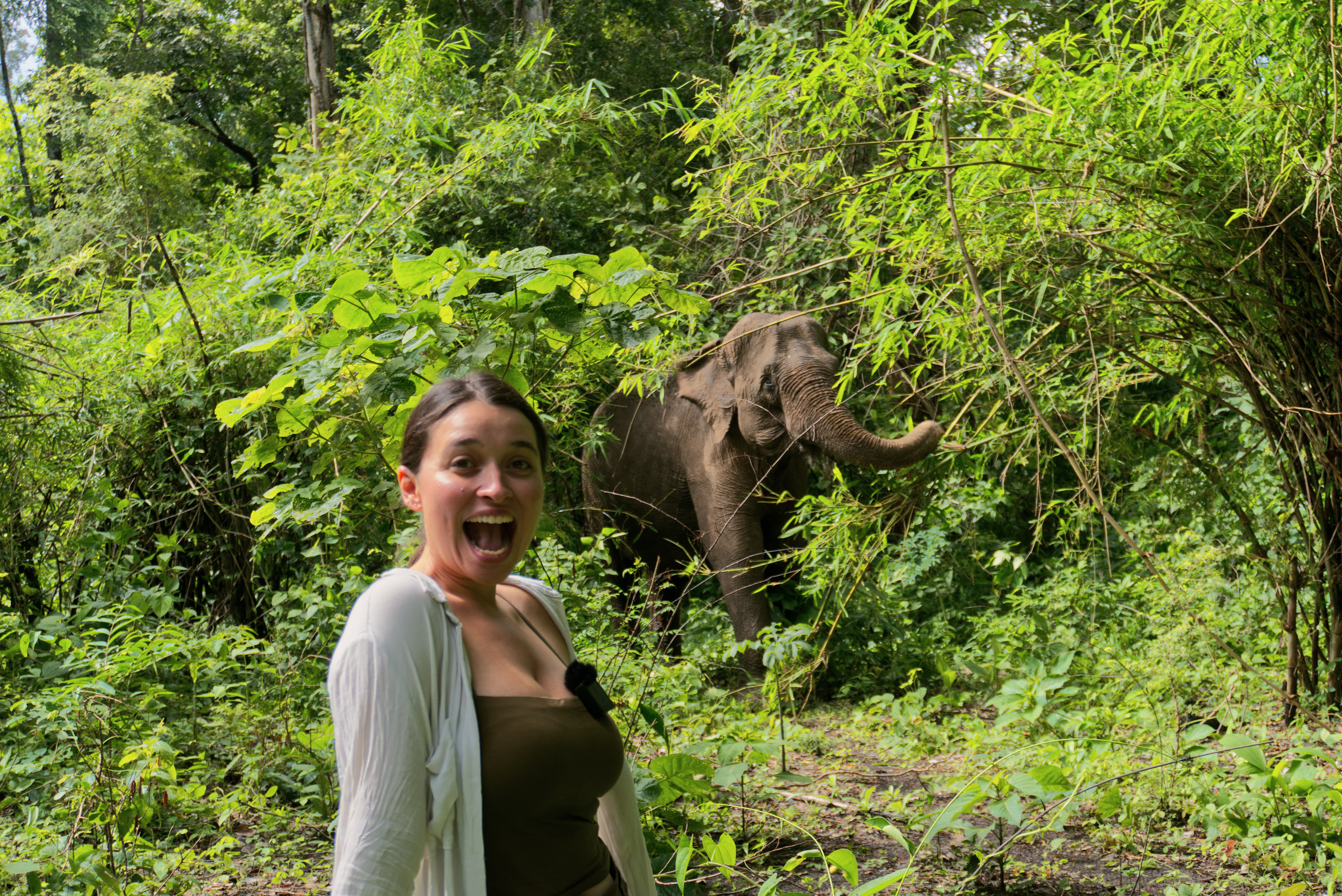
We arrived at an overflowing water crossing, and I worried we’d be stuck on the wrong side, missing out on our chance to catch a glimpse of the elephants. When suddenly…I saw a trunk off in the distance, giant flapping ears, humongous feet – this giant beast was the first elephant I’d ever seen in nature!

We were deep inside Yok Don National park, spreading over 115 thousand hectares in the Central Highlands of Vietnam. The park is about an hour ride by public bus from the closest city, Buon Ma Thout, in the region of Dak Lak.
The second we stepped off the bus, we were hit with torrential rains, soaking us and giving the hot and humid air a nice chill. We waited to see if the rain would calm down, or if we would have to wait until the next morning to head out for our elephant adventures. Luckily, the clouds soon parted and made way to gorgeous clear skies – perfect weather to go off exploring the forest.


Our local guide, Byly, drove us in an electric cart deep in the park until we came across Y’Khun and Bun Kham, accompanied by their mahouts.
Y’Khun, is 72 years old and used to belong to a local village who used her as ‘beast of burden’ to carry rice and other crops. Y Muk, her mahout, has been with her for the past twenty-five years. He calmly followed her around, keeping an eye on how she moves and never letting her get more than a couple of hundred feet away. As Y’Khun happily chomped down on bamboo, Y Muk relaxed into the well-known asian squat, and lit up a cigarette.
Y’Khun’s best buddy, Bun Kham, is 55 years old and was sold to the park in 1990. According to the National Park, whe was regarded as ‘disobedient’ by previous owners for retreating into the shade of trees and knocking the rice baskets off her back. Now, with her current mahout Khan, she is calm and collected.
The elephant experience at the national park is organized with the elephant’s well-being in mind. There is no human contact. No feeding, no bathing, and absolutely no riding. They currently have ten rescued elephants under their care at the moment, and each elephant is followed by its mahout during the day. For the tour, we follow the elephants along calmly and at a respectful distance – going where they want to go, not forcing them into activities they may or may not want to do.


The elephant tours in Yok Don National Park were created with Animals Asia, an NGO that ‘works across Asia to replace animal cruelty with compassion and create lasting change’.
Sanctuaries and conservation projects such as this one have their work cut out for them. Despite the fact that the National Park is a protected area, it is surrounded by farm land and impoverished communities that rely heavily on “unsustainable exploitation of forest resources”.
When thinking about the future of animal welfare, we need to think about all the obstacles, for elephants and animals – but also for the local communities. Which is why the tamed elephants here do have to be tied up into their own 40 square meter space at night, to make sure they don’t get harmed by the surrounding communities – or harm the surrounding communities.


This practice is common across elephant sanctuaries and according to the Animals Asia representative on site, the elephants show no signs of stress or struggle during this time. Despite sleeping only one to two hours per night, the elephants roam around calmly munching their way through different trees and bamboo.
Wildlife is supposed to be wild, with as little human intervention as possible. Of course, in today’s day and age humans have already caused so much damage that we need to now reverse. This is mostly the case with elephant conservation in South East Asia. Elephants have long been used as “beasts of burden”, to carry crops, logs, humans and then turned to exploitation through tourism. The caveat is that these animals are no longer wild: they don’t socialize as wild elephants would, they can have important health problems that need medical care, and can no longer protect themselves from other animal or human attacks without their herd.
Before visiting any wildlife sanctuary, it’s important to ask the right questions.
- Is there any human contact with the animals: riding, bathing, feeding?
- Are the animals free to roam as they wish? Are they enclosed?
- Who runs the sanctuary and are their claims to be ethical proven to be true?
You can book elephant tours with Yok Don National Park by contacting them through their website. We also spent the night at the rooms in the park, which were very basic but very affordable.
Public bus from Buon Ma Thuot to Yok Don National Park: 45,000 VND per person ($1,70)
Double room with AC in the park: 300,000 VND (~$11)
Half day elephant tour: 1,500,000 VND for 2 people (~$57)
Full day elephant tour: 2,800,000 VND for 2 people (~$106)