
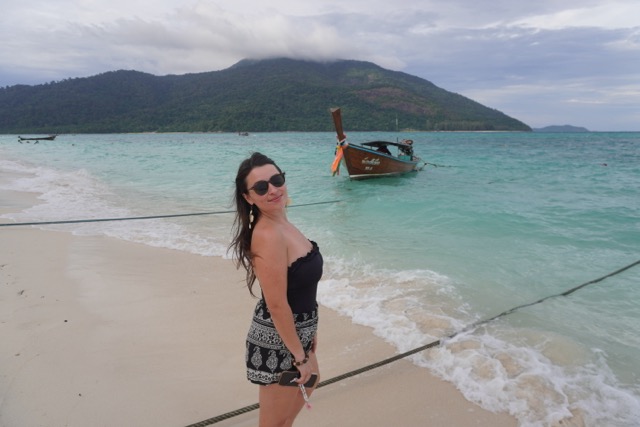
Our first steps in Thailand weren’t on land, but over water. We spent a month visiting Thailand’s breathtaking beaches and islands. From Koh Lipe to Phuket, we calculated the impact that our travels had on the once pristine waters we came to admire.
After a smooth and quick ferry ride from Langkawi, Malaysia1, we were ushered straight into a long wooden boat: the iconic Thai longtail. The front high bow adorned with garlands and flowers for safe passing, and the motorized “tail” as they call it, slapping in and out of the turquoise waves.

The longtail boat came about sometime in the 1930’s as a more affordable, and adaptable way of moving through Thailand’s shallow, narrow and busy waters. Whether that be in Bangkok’s river canals known as klongs, or in the southern island’s shallow coral reefs.
One man took the idea of automotive engines on boats to a new level, and alongside his brother developed and improved longtail boat motors since the 60’s. Read his moving story here.
After arriving on shore, we grabbed our bags and waited in line through customs to get our passports back – because, yes, they take away our passports when boarding to ensure we don’t run away from the border crossing! We made our way to our hotel, walking across burning hot, white sands, barefoot with our heavy backpacks and the sun weighing down on us.
Immediately, things feel different. It feels like a different world.
Straight out of a postcard, we snorkeled right off the beach in front of our hotel, spotting fish in the clear waters. After soaking in the sun of idyllic Koh Lipe, we took our first speed boat all the way to Koh Lanta.
Speed boats have a higher environmental impact, since they go faster, use more gas and carry less passengers than ferries – but unfortunately are sometimes the only option when moving around the islands in Thailand. For this five hour trip we calculated around 48.2 kilos of CO2 emissions per person, with speed boats emitting about 400% more than larger and slower ferries.
We did stop briefly to help another speed boat that was having some motor difficulties. Yet, despite braving a short storm in the middle of the ocean, the bumpy ride wasn’t as bad as a lot of online videos paint it. After five hours of roaring motors and crashing waves, we arrived in Koh Lanta.
Once known by its Malay name, “Pulao Satak”, which means “Long Beach Island” it became known as the island of “a million eyes” (“lan ta” in Thai), as many Thai people settled there.
Koh Lanta is bigger than the small and walkable Koh Lipe, and it became our home for two weeks. My parents came to visit and we spent the holidays together on the beach: morning runs, dips in the ocean, pad thai, fruit smoothies and some of the most gorgeous waters I have ever seen.


After a couple of weeks in sunny Koh Lanta, we moved to Krabi mainland, a two hour drive and a 15 minute ferry where everyone piles on in their cars. We calculated about 13 kilos of CO2 emissions per person for the trip.
We spent more time with family, and Alex’s parents and sister came to visit. January is the height of the tourist season in Thailand, with over 2.6 million foreign tourists recorded in the first month of 2026. In 2025 close to 33 million foreigners came to visit, which is almost of half of Thailand’s population.
Thailand is pushing tourism development hard in the upcoming years – focusing on what they call ‘quality tourists’. But one study analyses that despite claims of reducing tourist numbers to promote what they call ‘sustainable growth’ and potentially protect environments and ecosystems, no actions are being taken.


So here we were, hopping from island to island – doing exactly what we wanted to avoid for our travels: touristy boat tours, full of foreigners, where we go visit breathtaking beaches and coral reefs, and we’re told not to step on them, but the captain drops his anchor.
I don’t want to sound un-appreciative. We loved the time with our family. We had so much fun and Thailand is beautiful, offering us nature scenes that seemed more like a movie set than real before our eyes.
But, our travels left a bitter taste of guilt in my mouth. We weren’t doing what we had set out to do.
Was our enjoyment worth the ecological impact on these once pristine environments?
- We calculated around 3.1 kilos of CO2 emissions per person for the 2 hour ride. ↩︎