
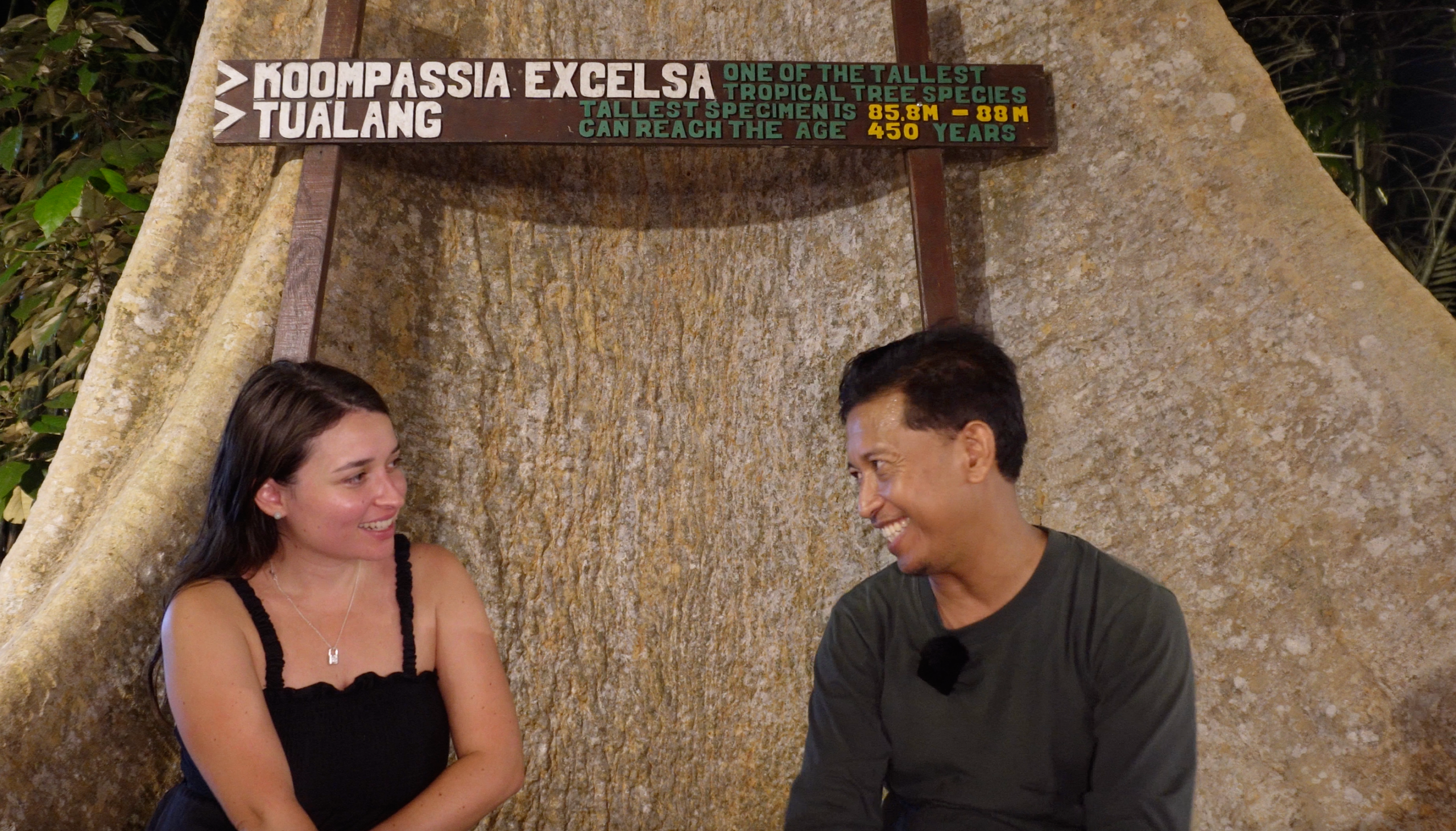
Born and raised in a once secluded forest only accessible by boat, Danz spoke to us about his home: the Malaysian National Park of Taman Negara. Owner of Danz Eco Resort, he hopes to improve the lives of the local community through sustainable tourism.
After an exhilarating ride in the back of his pick up truck, through off-road paths to make it to his river-side resort, he welcomed us warmly for a candle lit dinner underneath a beautifully grand tree. Once we had finished our delicious meal, he sat down with us for a chat.

Zoey: Thank you so much for doing this interview with us.
Danz: You’re welcome, Miss Zoey.
Z: If you could first introduce yourself, tell us where we are, and tell us about this beautiful tree.
D: My name is Mr. Danz. I was born here in Kuala Tahan, in Taman Negara. (Behind us), is one of the highest tree species in Malaysia, we call it the Koompasia Excelsa. So this tree is aged at about 350 years old and it is about 82 meters tall! And they can grow up to 88 meters tall.


Z: We’re here at your Eco Resort, which we looked around earlier, and it’s very beautiful. How long have you run the resort? Can you tell me more about it?
D: Yeah, so I’ve run Danz Eco Resort for 10 years already. I’m trying to focus on the eco concept. I use solar lamps, and I collect water from the rainforest.
Z: Is it hard to be eco-focused?
D: Yeah, it is really hard, because my resort is far from the village. We’re in an off-road situation, making it hard to get supplies.
Z: When you decided to open a business, did you always want it to be eco-friendly? Did you know that you wanted to be sustainable?
D: Yeah, of course, I always knew. I try my best. My place is 100% run by local people. Our boatmen and our guide are from the tribe people, the Orang Asli. 100% of our staff, housekeeping, and kitchen staff are all local people. I am proud.
Z: How has tourism impacted the local communities?
D: It’s positive for the local people. Taman Negara is one of the oldest rainforests in the world, 130 million years old. I hope many tourists come to Taman Negara and experience nature here. Right now, about 50% of tourists come from Malaysia, and then the other 50% are from Western countries.
Z: How do you feel that the community has changed in the past 10 years?
D: Actually, the boatmen, you know?
Before, there were about 40 boatmen in Taman Negara. But now, maybe they have 10 more boats. So, I think the economic gains for local people. For me, an extra 10 boats is very good if you compare the last 10 years.
Z: Have you seen a big impact on the animals and biodiversity?
D: Yeah, of course. I still remember, on the 39th day of COVID lockdowns, the elephants just came to our place, they just slept on our beach side. It was really nice. So, right now, with so many tourists, the elephants are still, they’re just further away.

Z: Is there something that you learned growing up surrounded by nature that you would like to share?
D: I still remember the 1980s. There was no electricity. You could only access the villages by boat. You could come across elephants just crossing the river! If you compare the 1980s to right now, 2025, more than 45 years later, it’s a really different situation.
The road to Kuala Tahan was finished in 1999 or 2000. But the road to my village, Kampung Kuala Sat was finished only in 2015. Kampung means small village in Malay.
Z: We also just learned that Taman Negara actually means national park!
D: Yes! All national parks are called Taman Negara followed by the name of the place. But here, we are special because it was the first national park in Malaysia! So here, we are simply called Taman Negara.
Z: To conclude our interview, is there something that you think tourists can do to travel in a sustainable way and help the local communities instead of harming them?
D: Oh, that’s a hard question to answer. The tribe’s people want to live the way they do. They don’t want to move to live in a “modern” society. But now, they also use mobile phones. They drive motorized boats. So, I think the biggest impact that tourists have is economic. It’s positive because tourists are providing economic gains for the local people.

I’m going to take a stab at answering my own question. I agree that it’s a hard question to answer, and something that I’ve been grappling with as we travel. Yet, if I stop overthinking for a minute to come up with a simple answer: the best way for tourists to travel sustainably and support locals is to do exactly that. Instead of staying at big chain hotels and booking activities online, be as direct as possible. Book family run hotels and homestays, book activities with the people who are actually heading the tours – not the companies who take half the profit.
It is, of course, a lot easier said than done, you have to spend a bit more time doing research. But the impact you have will be a lot bigger, and a lot better. One small caveat is to double check sustainability claims and think twice about any activity involving animals and nature: will your visit have an impact or cause harm? Is it worth the damage?
Danz welcomed us warmly, and his bright optimism shone through when talking to other hotel guests, his staff, or the two interns that he has taken under his wing. In conclusion, traveling is best done when we get to support and meet more people like him.
Laisser un commentaire